


Cricket has always been known as a sport that balances tradition with innovation. Over the decades, it has adapted to changing times — from timeless Test matches to fast-paced ODIs and electrifying T20 leagues. Now, in a major shift for the game’s future, a brand-new format called Test Twenty has been introduced. This hybrid format aims to bring together the thrill of shorter formats and the depth of classic Test cricket.
⚡ The Birth of a New Format
On October 16, 2025, cricket fans around the world witnessed the official launch of Test Twenty, a new experimental format designed to redefine the way red-ball cricket is played. The initiative is supported by several cricketing legends, including AB de Villiers, Matthew Hayden, Sir Clive Lloyd, and Harbhajan Singh.
The format has been created to attract a younger audience, especially players aged 13 to 19, while keeping the technical and strategic aspects of traditional cricket intact. The first official season of Test Twenty is expected to begin in January 2026, with a promise to make cricket more exciting, competitive, and inclusive.
What Makes Test Twenty Unique
Test Twenty is being called the “fourth format” of cricket — following Tests, One-Day Internationals (ODIs), and T20s. It combines the multi-innings system of Test matches with the speed and intensity of limited-overs cricket.
Here’s how it works:
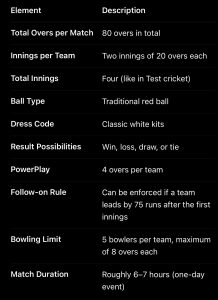
This new structure allows both batting and bowling teams to showcase skill, strategy, and endurance — but within a single day’s play.
The Philosophy Behind Test Twenty
The driving idea behind Test Twenty is balance. The creators wanted to design a format that retains the tactical complexity of Tests but fits the modern world’s fast-paced lifestyle.
Traditional Test matches last up to five days — which can be difficult to follow in today’s era of quick entertainment. On the other hand, T20 matches, though exciting, often sacrifice depth for speed. Test Twenty aims to bridge this gap — offering the best of both worlds.
It’s also seen as a development platform for young cricketers. Players will learn to handle red-ball conditions, manage innings pressure, and think strategically — all while playing in a fast, competitive environment.
The Structure of the League
The first Test Twenty league will feature six franchises — three based in India and three international teams representing London, Dubai, and the United States.
Each franchise will have a 16-player squad, with an equal mix of Indian and overseas players. Matches will be played in leading stadiums around the world, with the possibility of expansion in future seasons.
The format is expected to feature a round-robin stage followed by semi-finals and a grand final, all played in a one-day format.
How It Differs from Traditional Test Cricket
The introduction of Test Twenty doesn’t mean the end of traditional Test cricket. Instead, it serves as a complementary version, designed to keep the red-ball tradition alive in a changing era.
By condensing the Test match into a shorter form, Test Twenty allows players to experience the strategic layers of Test cricket without the extended time commitment.
Key Features and Rules
Some of the most innovative rules in Test Twenty include:
- Early Collapse Clause:
If a team is bowled out within a very low score in the first innings, extra overs are added to the second innings to maintain fairness. - Over-Rate Penalties:
Teams failing to maintain proper over rates will face run penalties — ensuring the match stays quick and entertaining. - Follow-On Rule:
If a team leads by 75 runs or more after the first innings, the opposing team can be forced to follow on — maintaining the spirit of classical Test cricket. - Limited Overs Control:
Each bowler can bowl a maximum of eight overs across the two innings, encouraging captains to rotate bowlers strategically. - PowerPlay Overs:
Every team gets four PowerPlay overs, allowing aggressive batting phases that heighten excitement.
Reactions from the Cricket World
The introduction of Test Twenty has drawn mixed reactions. Many former cricketers see it as a positive innovation that could protect the red-ball game’s future.
- AB de Villiers called it “a visionary step that could help youngsters fall in love with the art of Test cricket again.”
- Matthew Hayden praised the balance between entertainment and skill, saying it will “reignite the spirit of classical cricket in a modern format.”
However, some purists have expressed concerns. Critics argue that introducing another format may dilute the traditional Test structure and make the calendar even more crowded.
Still, most experts agree that experimentation is essential if cricket wants to stay relevant in today’s fast-moving digital world.
What the Future Holds
If successful, Test Twenty could become the bridge between domestic and international cricket, preparing young players for both T20 leagues and five-day Tests.
Organizers also plan to broadcast the matches globally with interactive fan experiences, real-time analytics, and shorter highlight packages to keep audiences engaged.
Moreover, the introduction of this format could inspire national boards and academies to adopt similar systems for talent development. Players will get the chance to practice long-format skills like swing bowling, defensive batting, and game management — without the time demands of traditional Tests.
Conclusion
The introduction of Test Twenty marks a bold and exciting step for cricket’s evolution. It’s a format that respects tradition while embracing change — giving fans, players, and broadcasters a new way to experience the game.
As cricket continues to adapt to modern audiences, Test Twenty could play a key role in preserving the essence of red-ball cricket in a world that craves speed and spectacle. Whether it becomes a long-term success or remains an experiment, one thing is certain — cricket’s future has never looked more innovative.